
- A GST tax invoice must show your name, address and GSTIN, a unique invoice number for the financial year, the date, the customer's details (and GSTIN if they are registered), each item with its HSN code, quantity and value, the GST rate and tax amount, and the place of supply.
- Selling inside your own state, you charge CGST + SGST (half each). Selling to another state, you charge IGST.
- In TejOrder the invoice number, date, totals and tax are filled in for you. GST is added only when the branch is linked to your GST registration.
What must be on a GST tax invoice?
Under GST rules (Rule 46 of the CGST Rules), a tax invoice has to carry these details:
- Your business name, address and GSTIN.
- An invoice number — in order, and used only once in the financial year.
- The date of the invoice.
- The customer's name, address and GSTIN, if the customer is GST-registered.
- For an unregistered customer and a bill of ₹50,000 or more: their name and address, the delivery address and the state name and code.
- The HSN code of the goods (or SAC for services) and a description of each item.
- Quantity and unit (like PCS, KGS or BOX).
- The total value, any discount, and the taxable value.
- The GST rate and tax amount, shown separately as CGST and SGST, or IGST (plus cess if any).
- The place of supply — the state name for a sale to another state.
- Whether tax is payable under reverse charge.
- Your signature or your authorised person's signature (a digital signature also works).
Invoice number rules
- Numbers must run in order, with no number used twice in the same financial year.
- A number can be up to 16 characters and may use letters, numbers, a hyphen (-) or a slash (/), like INV/26-27/0001.
- You may keep more than one series (for example one per branch), as long as each series follows these rules.
HSN code: 4 digits or 6?
The number of HSN digits you must print depends on your business's turnover in the previous financial year:
- Turnover up to ₹5 crore: a 4-digit HSN on invoices to registered customers (B2B). It is optional on bills to ordinary customers (B2C).
- Turnover above ₹5 crore: a 6-digit HSN on all invoices.
- Services use a SAC code in the same way.
CGST + SGST or IGST?
It depends on where the goods go (the place of supply), not on where the customer lives. For an item of ₹1,000 at 18% GST:
- Sale inside your state: CGST 9% = ₹90 and SGST 9% = ₹90. The customer pays ₹1,180.
- Sale to another state: IGST 18% = ₹180. The customer still pays ₹1,180.
- In a Union Territory without its own legislature (like Chandigarh), UTGST is used in place of SGST.
Tax invoice or bill of supply?
A composition dealer, or a seller of only GST-exempt goods, issues a bill of supply instead of a tax invoice — it has no GST on it. A composition dealer must also write "composition taxable person, not eligible to collect tax on supplies" on the bill. A business that is not registered for GST does not add GST at all.
How to make a GST invoice in TejOrder
- Set up GST once Add your GSTIN in Settings → Business Settings → GST Registrations and link it to your branch. Without this, bills are made without GST.
- Give each item its HSN code and GST rate Set these once when you add the item in Inventory → Items, so you don't type them on every bill.
-
Open a new sales invoice
Tap Add Sale in the top bar, or open Sales → Sales Invoice. The invoice number and today's date are filled in for you.
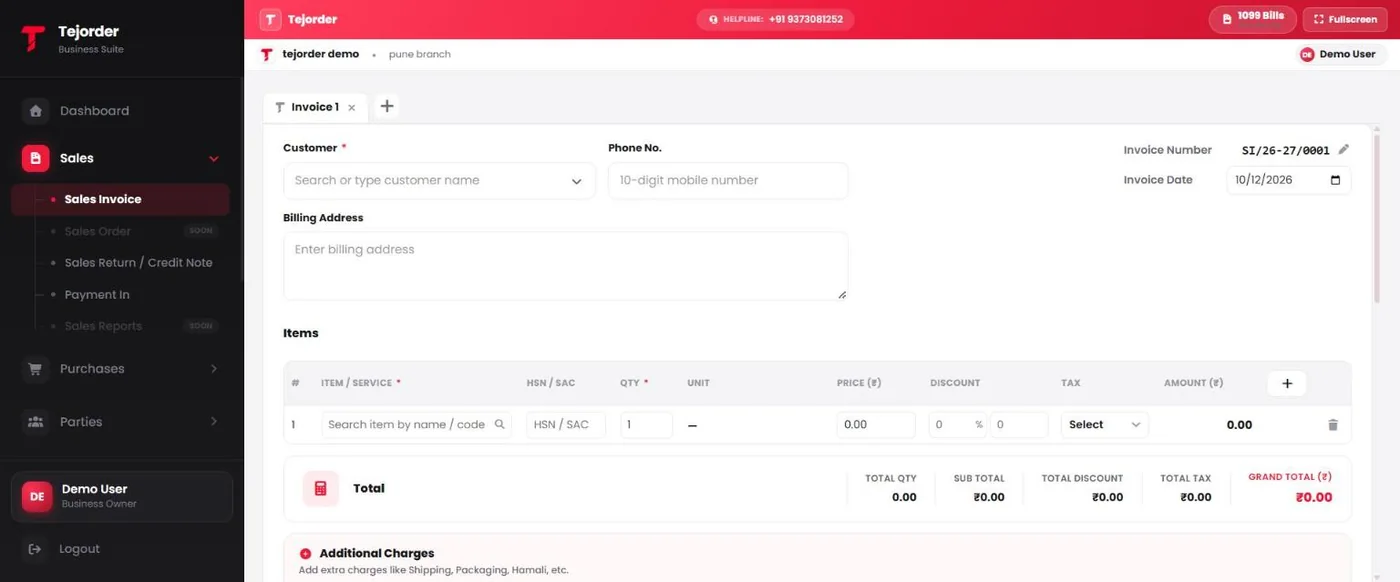
A new sales invoice in TejOrder. - Choose the customer Search or type the customer's name. For a registered customer, make sure their GSTIN is saved so it prints on the bill.
- Add items, check the total and post Search each item, set quantity, price and discount. The Total box shows sub total, discount, tax and grand total. When it is correct, post the invoice.
Common mistakes to avoid
- Skipping or repeating invoice numbers, or restarting the numbers in the middle of the year.
- Leaving out a registered customer's GSTIN — they then cannot claim input tax credit.
- A wrong HSN code or GST rate on an item — it repeats on every bill of that item.
- Charging IGST on a sale inside your own state, or CGST + SGST on a sale to another state.
Common questions
Do I need the customer's GSTIN on every bill?
Only when the customer is GST-registered (a B2B sale) — without it they cannot claim input tax credit. For an unregistered customer, their name and address, the delivery address and the state are needed when the bill is ₹50,000 or more.
Can invoice numbers start again from 1 every year?
Yes. A new series for each financial year is common, as long as every number is used only once in that year and the numbers run in order.
What are the GST rates now?
From 22 September 2025 most goods and services are taxed at 5% or 18%, luxury and sin goods at 40%, and some items are exempt. Check the rate for your HSN code on the GST portal or with your CA.
Does a draft invoice use up my TejOrder plan?
No. Drafts are free. One bill from your plan is used only when you post the invoice.
Next: set up GST for your shop →
Make your first GST bill today
Create a free TejOrder account — billing, stock, payments and reports in English, Hindi and Marathi, on any device.