
Short answer
- Put every credit (udhaar) sale on a proper bill, and record every rupee you receive as a payment with a receipt number. Then the amount each customer owes is always correct.
- In TejOrder, Sales → Payment In records the money. It is filled against the customer's oldest unpaid invoices first, and anything extra is kept as advance.
- Cash, UPI and bank can be split in one payment, and every payment gets a receipt number you can share.
Why the udhaar notebook goes wrong
- A payment is written on one page and the sale on another, so the balance is worked out by hand — and mistakes creep in.
- Part payments ("₹500 now, rest next week") are hard to match to the right bill.
- When the customer disagrees, there is no receipt number or date to check.
A simple system that works
- Every credit sale goes on a sales invoice — never only in the notebook.
- Every rupee received is recorded the same day as a payment, with the mode (cash, UPI or bank).
- Give the customer the receipt number, and note the UPI reference number for online payments.
- Once a week, look at who owes the most and for how long, and follow up.
Record a payment in TejOrder
-
Open Payment In
From the menu, open Sales → Payment In. You see all receipts of this financial year, with totals for this month, today and customer advance.
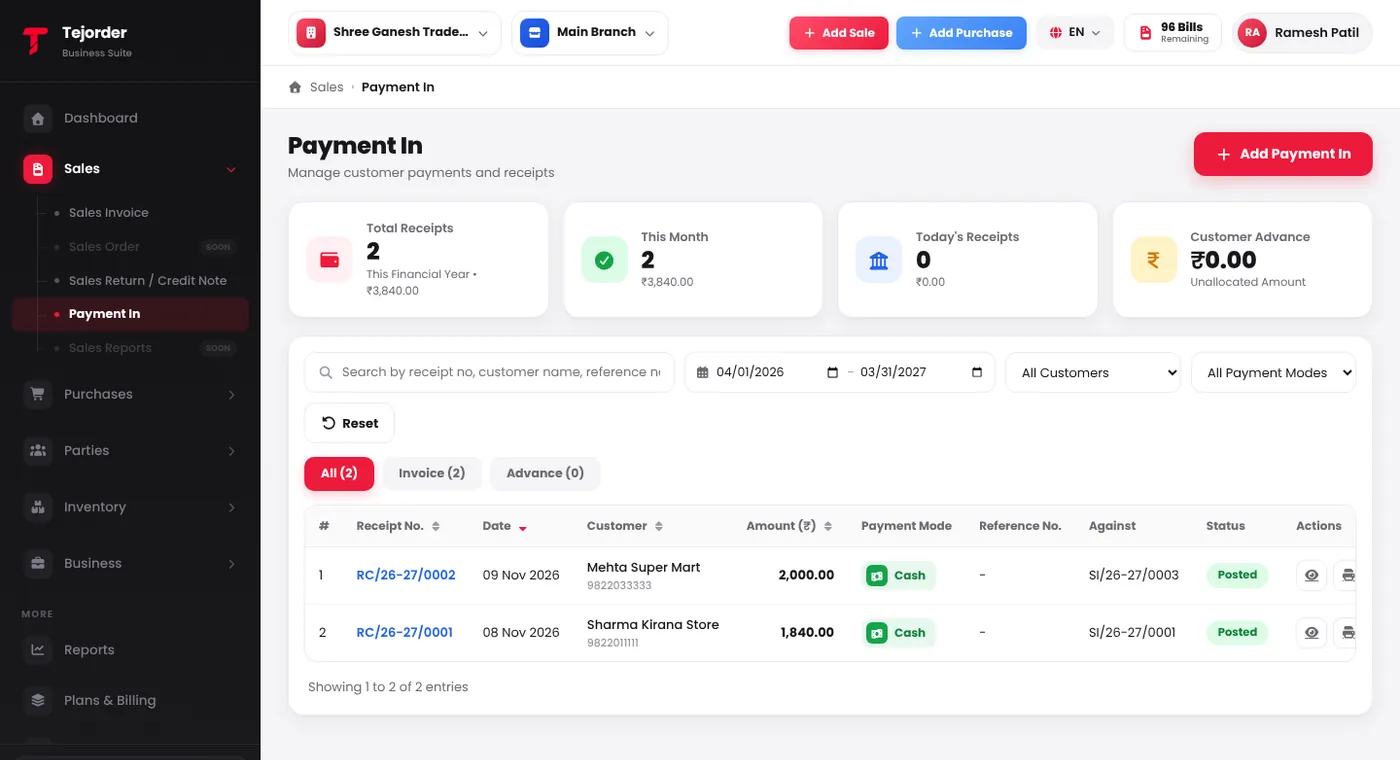
Sales → Payment In — every receipt with its customer, amount, mode and invoice. - Pick the customer Tap Add Payment In and search the customer. The amount you have to receive from them (Lena hai) shows next to the name.
- Type the amount by mode Type the amount in the row of the way you received it — Cash, or a UPI or bank account. If the customer paid part cash and part UPI, use both rows.
-
Check which invoices it pays
TejOrder fills the money into the oldest unpaid invoices first. To pay a different invoice, untick it or change its Allocate Amount.
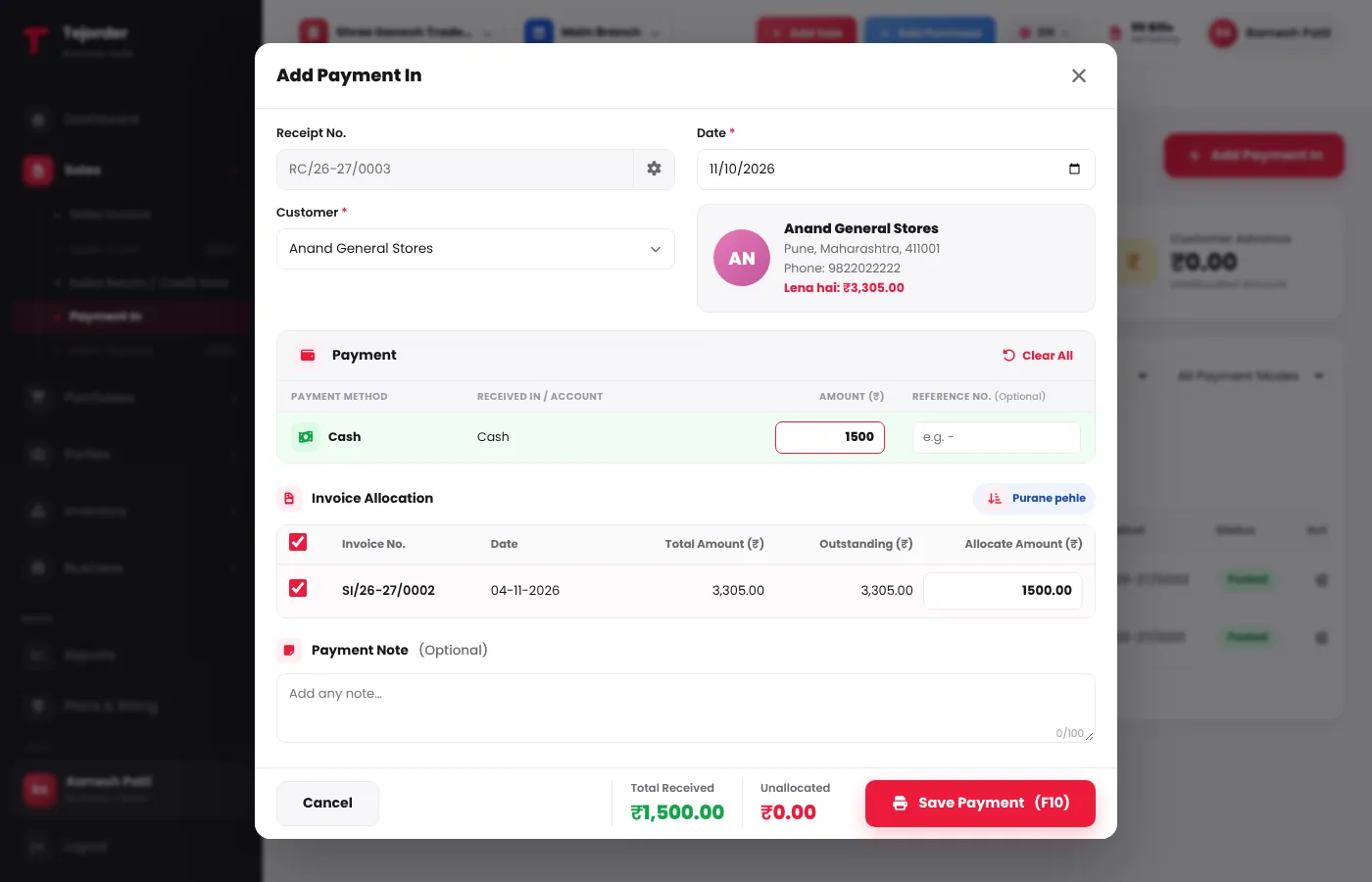
₹1,500 cash filled into the oldest unpaid invoice. - Save and share the receipt Tap Save Payment (F10). You get a receipt number like RC/26-27/0001 that you can print or share from the list.
When the customer pays in advance
Save the payment even if it is more than what the customer owes. The extra shows as Unallocated and is kept as the customer's advance — you can see the total in the Customer Advance card.
A customer returned goods? Make a sales return — TejOrder makes the credit note and reduces what the customer owes.
Common questions
Does recording a payment use a bill from my TejOrder plan?
No. A Payment In does not use a bill. Only posting a sales invoice uses one.
The customer is paying for one particular bill, not the oldest. What do I do?
In the invoice list of the payment, untick the other invoices or change the Allocate Amount so the money goes to the bill the customer named.
I don't see my UPI or bank account as a payment option.
Add them in Settings → Payment Settings. They then show as rows in the payment table.
Make your first GST bill today
Create a free TejOrder account — billing, stock, payments and reports in English, Hindi and Marathi, on any device.